

01 — Your weekends
Somewhere worth slowing down.
Coffee by the coast. A familiar road with someone you love. A classic VW Bus, reimagined for the next chapter.
Duet builds mostly-electric vehicles that are renewed instead of replaced. We start with the classic VW Bus, and every Bus we build proves the standard parts that will carry these ideas much further. Four principles guide every decision.
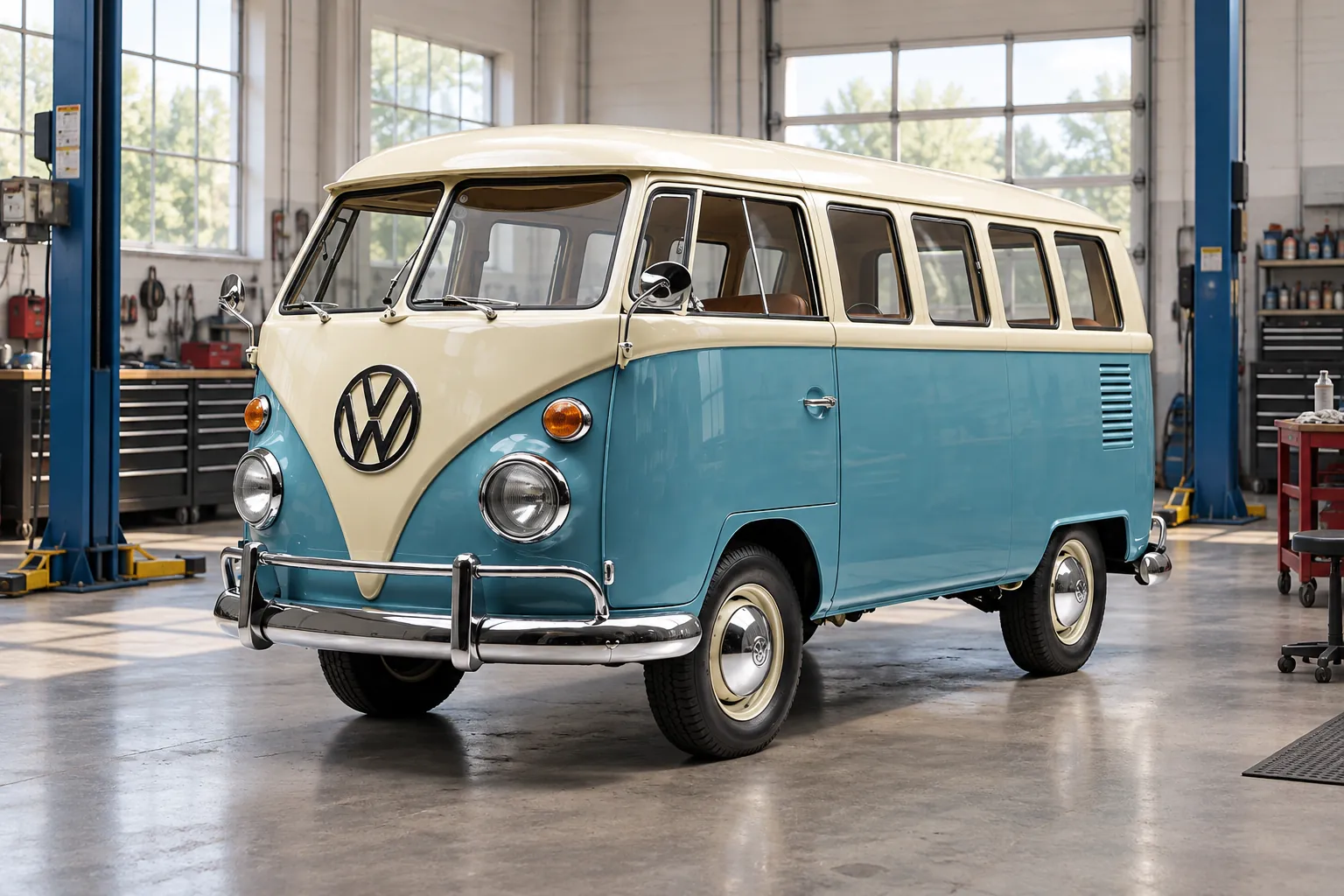
The best car is one that never has to be thrown away. Keep what people love; swap out what wears out.

People keep the things they love. A car worth keeping has to be worth looking at.

A better car that only a few can afford changes little. Standard parts are how we bring the price down.
A car pollutes twice: once when it is built, and every mile after. We work on both.
Every Bus we build teaches us how to make the next vehicle cheaper, cleaner and longer-lived.
Duet Drive is developing its first restored VW Bus. Orders are not open, no Duet Bus has been delivered, and we have not announced a delivery date.
Specifications have not yet been finalized. The configurator and simulators are concept previews. Joining the waitlist is free, with no deposit or purchase commitment.
AI concept illustrations. No completed customer vehicles are shown. Specifications have not yet been finalized.
Seat support, getting in and out, cabin temperature and conversation at highway speed all matter. We’re evaluating seating, air conditioning and insulation; final equipment and test results are still to come.
People, bags and the things you take along. Seating capacity, seat belts, luggage space and optional cabin layouts will be confirmed before orders open. Tell us how you would use yours.
Home charging, brakes, service, warranty and parts support deserve clear answers. The charging connection, brake specification and support terms are not finalized. We’ll share them before taking orders.
It turns a generator. Everything that moves the bus is electric, so it pulls like an electric car and refuels at any pump in the country. Plug in for local electric driving; use the generator for longer trips.
Electric for power.
The Duet Bus combines plug-in driving for local trips with gasoline refueling for longer journeys. Here’s how range and roadside stops compare.
1965 split-window · Gasoline
2025 US model · Rear-wheel drive · Electric
Classic Volkswagen · Electric & Gas
The Duet Bus’s calculated total range is 375–430 miles at 55 mph, or 310–350 miles at 65 mph. At 70 mph, the equivalent estimate is 285–325 miles. Battery-only range at 65 mph is approximately 65–85 miles. Its figures are engineering estimates, not tested or EPA-rated range; all fuel-based estimates use a 10.6-gallon usable tank. These vehicles use different range methods, so this is not a same-route test. Gas stop times are planning estimates. All stop times exclude queues and detours.
Original Bus: Volkswagen’s 1965 owner’s manual lists approximately 250 miles from a 10.6 US gallon tank. Vehicle condition and driving conditions affect actual range.
ID. Buzz: VW’s US 2025 RWD specifications give 234 EPA-estimated miles.VW quotes 10–80% charging in 26 minutes under suitable conditions. The 164-mile figure is 70% of EPA range, not measured highway range. Charging speed varies with battery temperature, charge level, charger output and other conditions.
Duet Bus: 36–40 kWh gross, 28.8–36 kWh usable at the electrical bus, approximately 4,000 lb operating weight, Cd 0.45, 2.67 m² frontal area, 2 kW auxiliaries and level-road driving. The model uses 34–36% engine thermal efficiency while running, 94% generator efficiency, 89–93% electrical-to-wheel efficiency and 92% battery round-trip efficiency. At an illustrative 50 kW generation point, the engine runs about 58–60% of the time at 65 mph, supplying the motor and charging the battery, then stops. The exact Ford 1.5L operating point and these efficiencies have not been measured. Gasoline replenishes generator fuel, not battery charge. Plug-in replenishment of the usable battery window takes approximately 5–7 hours with the 6.6 kW charger and a suitable 240 V supply, allowing for charging losses. Wind, hills, heating, load and final hardware change these estimates. The How it works simulator uses the conservative efficiency case and an 80% usable DC window. Its standard build uses 36 kWh gross; the larger build uses 40 kWh gross. The favorable end of this comparison also assumes better efficiencies and a wider usable window, so choosing the larger battery alone does not reproduce the upper bound. Acceleration and the final partial engine cycle can make a simulated trip differ slightly from the steady-road estimate.
Engine-efficiency assumptions are informed by EPA benchmarking of other EcoBoost engines, not a verified 1.5L map. Charge-and-stop operation is included in the calculation; engine-off time is not an additional range multiplier. These warm-operation scenarios do not quantify cold-start or restart overhead.
Paint, trim, wheels and accessories. The drivetrain is the same in every one. Specifications have not yet been finalized.
Tax, title and delivery are additional. Joining the waitlist is free, takes no payment and does not reserve a vehicle or create a purchase commitment. Images are concept illustrations for reference only. Specifications have not yet been finalized. Volkswagen and VW are trademarks of Volkswagen AG; Duet Drive is not affiliated with Volkswagen.
Get build updates and first word when orders open. One email a month at most. Free to join. No deposit.